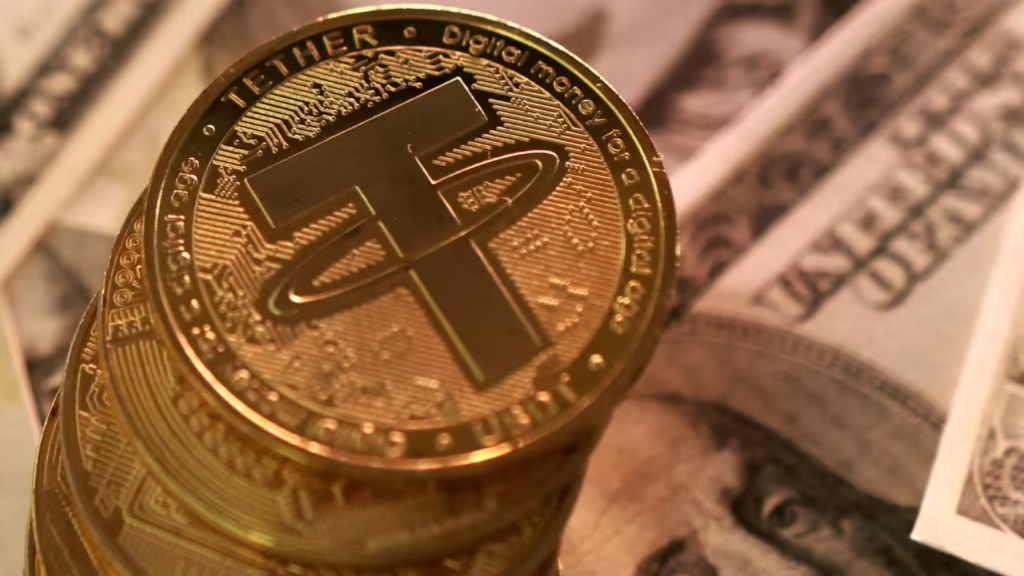
Tether (the FinTech firm best known for issuing USDT, the world’s largest stablecoin by market capitalisation) has an appetite for gold that rivals Mansa Musa. According to investment bank Jefferies, Tether held approximately 116 tonnes of gold in its reserves by the end of Q3 2025 – its purchases in Q3 were equivalent to 2% of all global gold demand.
These purchases are underpinned by Tether’s belief in ‘tokenised physical gold’. The concept is that Tether holds gold, issues tokens corresponding to the gold, and those tokens are equivalent to ownership of the gold. On paper it sounds ideal in a time of market volatility and increased investor appetite for gold: why hide gold under the bed when it can be held securely by Tether (for a small fee).
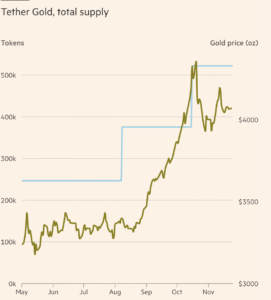
FT Alphaville captured a potential hitch:
All that’s needed now is to convince risk-averse investors that their fears are best expressed through buying blockchain tokens from a privately owned, El Salvador-licensed crypto firm that says it has more than 100 unaudited tonnes of gold bars in an unidentified warehouse somewhere in Switzerland.
Underpinning this scepticism is an interesting legal issue: if Tether were to become insolvent, would holders of the Gold Tokens (XAUt) have a property right in the gold that would protect them from Tether’s creditors?
Fool’s Gold
To assuage any nervous investor, Tether makes a simple pitch:
Tether Gold (XAUt) is a token that provides you ownership of real physical gold.
The main problem for any Token holder is that to have a property right, they need to say what property that right covers (to use the legal phrase ‘certainty of subject matter’). Tether’s T&Cs makes this difficult for two reasons:
- The gold held by Tether is in Tether’s “gold reserves”. Each Token corresponds to a bar of gold in Tether’s Swiss warehouses, but Tether does not specify which bar. This is problematic because goods must be ascertained for property in them to pass (Re London Wine Company (Shippers Ltd) [1986] PCC 121). Unless the specific ounces are individually segregated, property in the gold will not pass to specific Token holders.
- Tether can change which ounce of gold each Token is subject to. The T&Cs provide: “The undivided interest in a fine troy ounce on a specific bullion bar in the Gold Reserves owned through a Gold Token may be reallocated by Tether Gold on behalf of the Gold Token holders, from time to time and without notice, to a fine troy ounce on a different specific bar of gold in the Gold Reserves”. For goods to be ascertained they must be segregated (Re Goldcorp Exchange Ltd [1995] 1 AC 74) – if Tether can change the gold that each Token corresponds to then each customer’s assets are not separated.
In sum, the gold backing XAUt is part of a bulk rather than individually set aside ounces clearly attributable to specified Token owners. It may be possible for crypto-friendly jurisdictions (such as El Salvador) to develop new legal mechanisms to remedy this gap in the law – potentially by treating the Token holders more akin to shareholders. However, Tether’s only real solution under English law would be segregation of the gold, a costly and impractical solution.