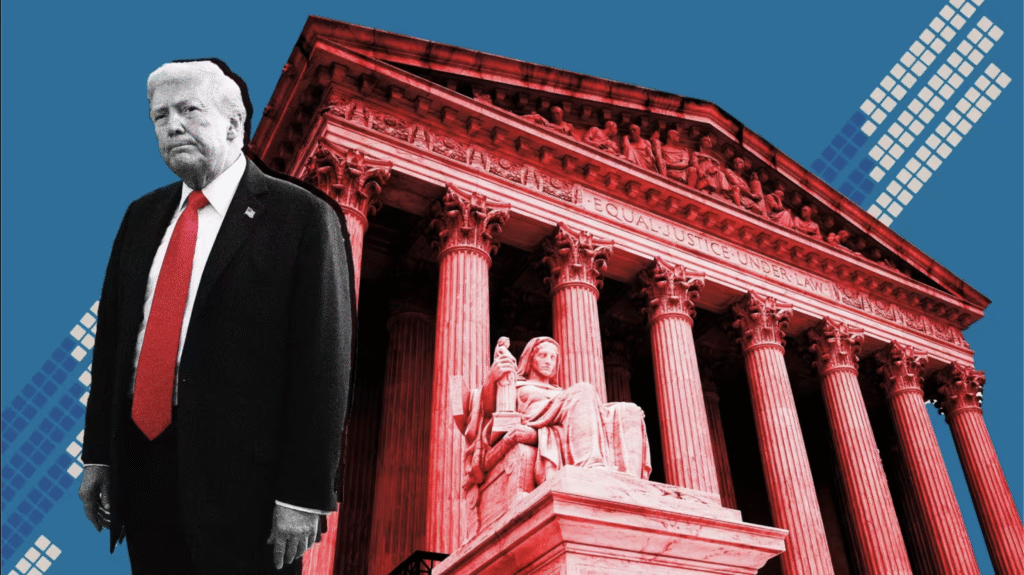
On September 9th the US Supreme Court agreed to hear an appeal in V.O.S. Selections Inc. v. Trump. The Court will decide if the tariffs imposed by President Trump under IEPEA—which covers most tariffs, except for certain sector-specific levies—are unlawful. It is uncertain whether the Supreme Court will side with President Trump, but an upset is not entirely off the cards.
The ramifications of a tariff cancellation would be monumental: businesses have made consequential investment decisions with US tariffs in mind, nations have made significant concessions to secure favourable trade deals, and bond investors have relied on tariff revenue to satisfy a budget that is otherwise insouciant about the deficit. The effects of any tariff reversal would thus be drastic for many investors and companies, and for some, adverse.
MAE madness
Material Adverse Change (MAC)/Material Adverse Event (MAE) clauses, at first glance, appear quite distant from issues of US constitutional and trade law. MAE clauses aim to distribute the risk of significant disruptions or cancellations affecting a business. A typical MAE clause holds:
“Material Adverse Effect” means any change, event or effect that individually or in the aggregate is or would reasonably be expected to be material and adverse to the business […] in connection with or resulting from [certain specified conditions].
If an MAE occurs a party can stop performing their obligations under the contract. For example, the buyer may be allowed to exit a share purchase agreement (SPA) if the target company becomes embroiled in a significant scandal.
As one of the primary ways for businesses to distribute the risk of significant change or disruption, they are in the forefront of any discussion about a tariff reversal. Sibanye ([2024] EWHC 2566 (Comm)), the leading UK authority, provides relevant guidance:
- Ordinary principles of contract construction apply. The court will consider the ordinary and natural meaning of the words used, in combination with the factual matrix to guide the interpretation (see Wood v Capita Insurance Services [2017] UKSC 24). Trade uncertainty will certainly have been in the background of any international contracts negotiated within the past 9 months; however, a change in US trade policy could still be recognised as an adverse effect, particularly if the contract specifies changes in trade policy as a triggering condition. The High Court recognised both in Sibayne and Travelport Ltd v Wex Inc ([2020] EWHC 2670 (Comm)) that complex and sophisticated agreements drafted by skilled legal advisers can be interpreted via a textual analysis. An MAE clause would therefore need to specify trade policy as a qualifying event to be triggered by an adverse Supreme Court decision—businesses are aware of trade uncertainty, if they did not include it in the contract then that will be conclusive.
- For an MAE to have occurred, the “change, event or effect” must, itself, have been material and adverse. This reasoning is particularly challenging given the complexity of trade and tariff policy. The Court made clear that the consequences of the ‘change, event or effect’ could be considered, but only insofar as they “quantify or illuminate the significance which the ‘change, event or effect’ itself has or would reasonably be expected to have”. If the Supreme Court’s decision significantly reduces the value of a company (for example one that had a large amount of US manufacturing relative to its competitors) then this could suffice for an MAE. However, if the decision were to cause a general sell-off in US markets – with most share prices deteriorating – then this is unlikely to have ‘illuminated’ anything new, rather illustrated that markets were already unsettled.
- An ‘effect’ is an alteration or influence of the business of the company. The example given by the Court of a virus circulating before signature, but where it only became significant after closing ([238]) is pertinent. Two US decisions have already declared the tariffs unlawful. A third decision by the Supreme Court confirming this could be seen as analogous to the virus for those businesses that have signed after the existing decisions—what was previously a background risk that there would be a sudden change in US trade policy has become a real event. Businesses that entered contracts between the first decision and now likely could avail themselves of an MAE clause.
- US case-law may be helpful, but there is no special principle that MAE clauses must be construed narrowly. The guidance in Snow Phipps Group LLC v KCake Acquistion Inc (Court of Chancery of Delaware, Memorandum Opinion 30 April 2021, McCormick VC) is applicable here:
To assess whether a financial decline has had or would reasonably be expected to have a sufficiently material effect, this court will look to ‘whether there has been an adverse change to the target’s business that is consequential to the company’s long-term earnings power over a commercially reasonable period.’
The impact of any US decision would therefore need to go beyond a simple change in a business’s stock price. There would instead need to be a more fundamental change in its earning capacity.
An adverse conclusion
MAE clauses will not be a saviour for every business that is affected by the Supreme Court’s decision. The MAE clause must have specifically referenced changes in US trade policy, the decision must have directly caused a material impact on the business and have long lasting implications on the business’s earning capacity. Companies that negotiated clearly for each scenario will, as ever, be those which are best placed to navigate the uncertainty.